QS-1000G-B Simple Palletizing System
Simple palletizing system for near-square pallet groups in about 16 seconds a layer.
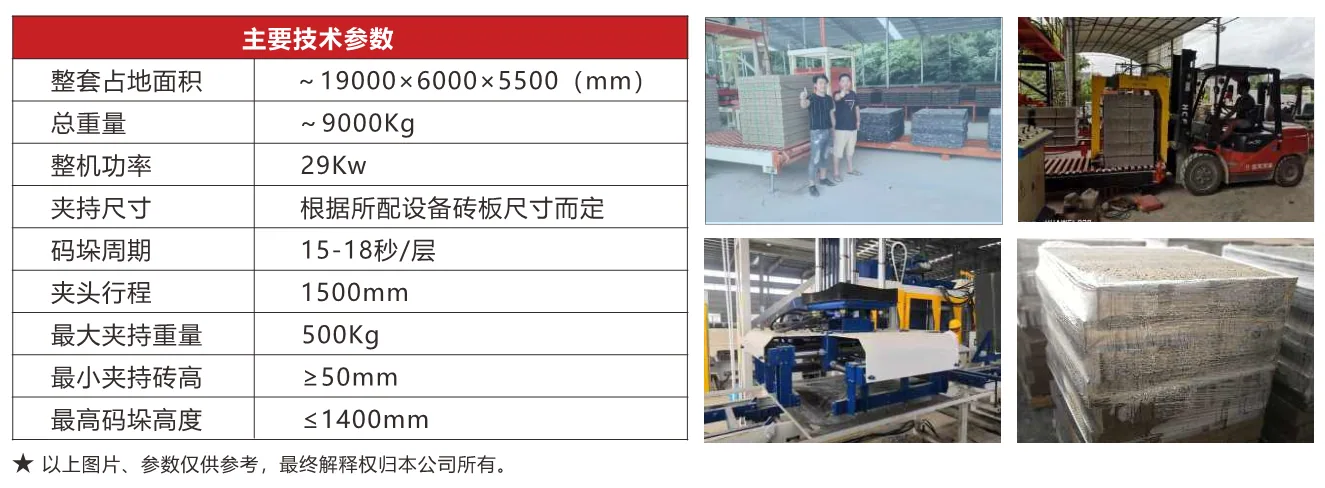
The QS-1000G-B is a simple palletizing system for products formed on brick-supporting pallets. When the combined pallet group is close to square, or when two pallets together form a near square, the system separates bricks from the pallets and palletizes them directly, with no need to sort individual bricks first. The line includes a board feeder, a board lifter, a board pusher, a gantry-type high-position palletizer, a heavy-duty chain conveyor, an electrical control system and a hydraulic system. PLC and touch-screen control with intelligent sensors runs the line unmanned. On a fault, the machine stops, alarms and shows the fault location, so a user can find the problem without a specialist. Separate electrical, pneumatic and hydraulic circuits keep the motion smooth and continuous. It takes about 16 seconds to palletize one layer, with a daily output of around 2,000 pallets. Paired with a forklift clamp, it also handles pallet-free transport and loading.
Configured around output, blocks and operating conditions.
Pallets near-square pallet groups directly without sorting individual bricks first., Suits cases where one pallet or two combined pallets form a near-square shape., Includes board feeder, lifter, pusher, gantry high-position palletizer and heavy-duty chain conveyor., PLC and touch-screen control with intelligent sensors runs the line unattended., About 16 seconds per layer gives a daily output of roughly 2,000 pallets., Pairs with a forklift clamp for pallet-free transport and loading.
Typical decision factors
What changes the machine price?
Daily capacity
Output target determines machine size, mould cycles and line configuration.
Automation
Pallet handling, cubing, batching and packaging change total project scope.
Block types
Hollow block, paver, interlock and curbstone may require different moulds and handling.
Service scope
Shipping, installation, training and spare parts are quoted by destination.
The QS-1000G-B simple palletizing system handles products formed on brick-supporting pallets. When the combined pallet group is close to square, or when two pallets together are nearly square, the system can separate bricks from the pallets and palletize them directly. That removes the need to sort individual bricks first, which simplifies the whole flow.
Designed for Near-Square Pallet Groups
The unit is built for lines where products come off pallets in a form that is already close to a square, or where two pallets together make a near square. In that case a plant can separate bricks from the pallets and move straight to palletizing without sorting single bricks, saving a handling step and reducing labor.
Equipment and Control
The system includes a board feeder, a board lifter, a board pusher, a gantry-type high-position palletizer, a heavy-duty chain conveyor, an electrical control system and a hydraulic system. PLC plus touch-screen control works with intelligent sensors to run the line unattended. On a fault, the machine stops, arrives an alarm and shows the fault location, so a user can troubleshoot without a specialist. Separate electrical, pneumatic and hydraulic controls do not interfere with each other, which keeps the motion smooth and continuous.
Cycle and Daily Output
It takes about 16 seconds to palletize one layer, with a daily output of around 2,000 pallets. That pace lets a plant keep a steady flow from the forming machine through to the finished stack, and it removes the labor and inconsistency of manual palletizing teams.
Pallet-Free Handling Option
Paired with a forklift clamp, the system can handle pallet-free transport and loading. This suits plants that want to move finished stacks without keeping pallets under every load, which can lower pallet demand around the yard.
Why Use a Simple Palletizer
Not every line needs a full palletizing upgrade. Where products already come off the pallets in a near-square group, a simple system does the job without the cost and footprint of a heavier setup. It separates bricks from pallets and stacks them directly, so a plant gets automated palletizing with a shorter installation and a smaller site footprint than a high-position line. The combination of the board feeder, lifter and pusher with the gantry palletizer lets the unit handle the flow with minimal touching, and the PLC control keeps the cycle repeatable from shift to shift.