Concrete Block Production Line
Complete production line covering batching, forming, handling and cubing.
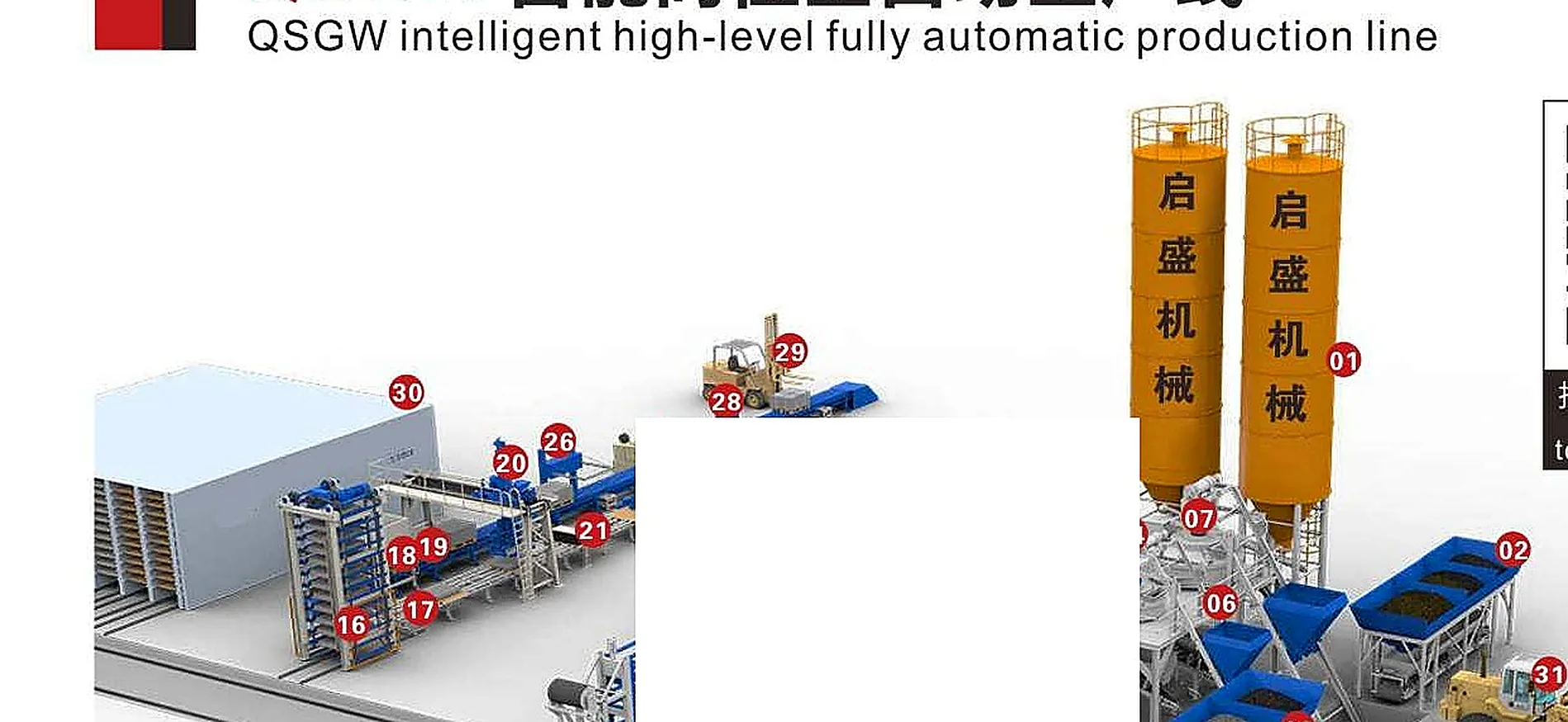
A concrete block production line runs from batching and mixing through moulding, curing, cubing and packing, and the host machine and the curing system set the output. This page covers the QSGW, QSDJ and QSRGY line families, the real capacity range from 30,000 to 250,000 pieces per shift, the equipment list and the factors that decide cost for buyers in Syria and the Middle East.
Configured around output, blocks and operating conditions.
PLC control, hydraulic forming, replaceable moulds, configurable automation, installation and training support.
Typical decision factors
What changes the machine price?
Daily capacity
Output target determines machine size, mould cycles and line configuration.
Automation
Pallet handling, cubing, batching and packaging change total project scope.
Block types
Hollow block, paver, interlock and curbstone may require different moulds and handling.
Service scope
Shipping, installation, training and spare parts are quoted by destination.
What a Concrete Block Production Line Produces
A concrete block production line turns cement, aggregate and water into cured, stacked and packed blocks. It strings together batching and mixing, the block machine, the curing system, the cubing and the packing, and the host machine decides how fast the whole line runs.
The QSGW line is built for a wide product mix. It handles permeable pavers, imitation-stone PC bricks, kerb stones, hollow blocks and thin-wall insulation blocks, which lets one plant sell into road work, landscape and housing at the same time. The product mix is set by the moulds on the host and by the curing and cubing capacity behind it, so the two are planned together.
- Permeable pavers and imitation-stone PC bricks
- Kerb stones and road edging
- Hollow load-bearing and partition blocks
- Thin-wall insulation blocks
- Standard solid bricks and interlocking pavers
Write down the products in the order you will sell them. The first product sets the host moulds and the curing schedule, and the later products decide how much curing and cubing capacity the line needs. A line sized to the first product alone usually has to be extended within a year.
Line Families: QSGW, QSDJ and QSRGY
Three line families cover different sites and budgets, and they differ most in how they handle curing.
QSGW is the intelligent high-level fully automatic line. It is a closed-loop, three-dimensional plant that joins batching and mixing, pre-forming, high-level transfer and curing, brick dividing and cubing, and automatic packaging into one automatic cycle, run by a central computer with PLC and sensors. Its curing system uses a layered automatic pallet lifter, a high-level finger car and a three-dimensional curing kiln, and the whole line is designed to your site area and target capacity. It runs with 3 to 6 persons per shift depending on configuration.
QSDJ is the belt-rack curing line. It is a rack-curing automatic line that can be matched to the block machine of any maker, new or existing. Its transport sub-car runs on a new-energy lithium battery with wireless control, and the line self-organises an RS-485 wireless network with cloud remote monitoring. Each layer of brick is lifted and stored on an isolated rack level. The line includes a pallet lifter, a lowering machine, heavy and empty pallet conveyors, a transport sub-car, a shuttle mother car, a smart charging pile, an automatic control system and an automatic cuber system.
QSRGY is the finger-car curing line. It upgrades the classic chain-conveyor shuttle line and carries multiple national patents. It runs single-layer curing as standard, or multi-layer curing to use the full height of the building. The sub-car takes power either from the running rail, at 380 V AC stepped down by a special transformer to 36 V DC, or from a 36 V lithium battery with BMS and an automatic charging pile. Positioning uses encoder distance on the mother car and precise per-stack positioning on the sub-car. Fault handling stops the line, alarms and shows the fault position without a specialist, and 3 to 4 persons complete the whole production task.
| Line | Line type | Curing approach | Host compatibility | Typical labour |
|---|---|---|---|---|
| QSGW | Fully automatic, closed-loop 3D | High-level transfer and 3D curing kiln | Matched to capacity requirement, QST series | 3 to 6 persons |
| QSDJ | Fully automatic, rack curing | Isolated rack level per layer | Any maker, any model | Depends on configuration |
| QSRGY | Intelligent finger-car curing | Single layer standard, multi-layer optional | Any maker, new or existing | 3 to 4 persons |
Choose by what you already have and what you can build. A greenfield site that wants one automatic cycle fits QSGW. A plant that already runs a block machine and wants to add automatic curing and cubing fits QSDJ or QSRGY, because both accept a host of any maker. A plant with a tall building fits QSRGY multi-layer curing, which uses height instead of floor area.
Concrete Block Production Line Capacity and Output
The line output is set by the host machine, not by the conveyor. The QSGW is configured from 30,000 to 250,000 pieces per 8-hour shift depending on the host machine matched into it.
| Output band | Host machine | Typical products | Condition |
|---|---|---|---|
| 30,000 to 250,000 pcs per 8-hour shift | QST series host selected to the target | Pavers, kerb stones, hollow blocks, thin-wall units | Depends on host, mould, cycle, shift and mix stability |
Read the range as a menu rather than a promise. A line set to 30,000 pieces a day may run a single host across one shift, while 250,000 pieces needs a larger host, a matching curing footprint and enough pallets to keep the line fed. The curing system, the cubing capacity and the pallet pool must all be sized to the same number, or the line waits at its slowest link.
Three things decide where your plant sits in the range: the host machine, the curing and stacking capacity behind it, and the pallet pool. Ask for the line to be quoted at your target output together with the pallet count that target needs, because the pallet count is what turns a stated figure into a real one.
Raw Materials the Line Handles
The line runs on the same dry-cast materials as a single block machine: cement, sand, gravel and crushed stone powder, with optional construction waste, slag, fly ash and gangue in place of part of the aggregate when the gradation is controlled.
- Cement as the binder
- Sand and gravel or crushed stone as the aggregate
- Construction waste, slag, fly ash and gangue as partial aggregate
- Water, held consistent across the whole shift
On a full line, batching accuracy matters more than on a single machine, because the plant runs at the host cycle all day. A batching machine such as the PL series doses fast then slow to a pre-set aggregate ratio and weighs with three-point induction sensors, and a mixer such as the CMP vertical shaft planetary mixer gives a uniform batch. On a high-output line an uneven batch does not stay local; it shows up across the cured stack, which is where the loss is hard to recover.
Main Components and Equipment List
A complete concrete block production line is a chain, and every link has to match the host.
- Batching and mixing: aggregate dosing and a mixer, such as the PL series and the CMP vertical shaft planetary mixer
- Pre-forming: the block machine, on the QST series
- Pallet handling: an automatic pallet feeding machine such as the QS-1200, cycling in about 13 seconds
- Curing: high-level transfer and kiln on QSGW, rack curing on QSDJ, finger-car curing on QSRGY
- Cubing: a cuber system, from the QS-1200A low-position cuber at about 3,800 pallets per shift to the high-level self-retaining hole cuber
- Packing: a baler such as the QSSX-16A or QSPY-16A, and a wrapper or forklift clamp for dispatch
- Control: a central computer with PLC, sensors and, on some lines, cloud remote monitoring
The cuber is often the quiet constraint. A line that moulds faster than it can cube stores green blocks, and green blocks that wait lose strength. On the QSGW, automatic packaging closes the loop so the product leaves the line packed and stackable. Match the cuber and the baler to the host cycle, not to the host's best day.
What Affects the Cost of a Concrete Block Production Line
There is no single price for a concrete block production line. The host machine, the curing system and the automation level are the three big items, and everything else scales around them.
- The host machine model and its pallet size
- The curing approach: a high-level kiln on QSGW, rack curing on QSDJ, finger-car curing on QSRGY
- The automation level, from a fully automatic closed loop to a simpler manual stage
- The number of moulds for the product mix
- The cubing and packing equipment and how automatic it is
- The pallet pool, which ships as steel weight
- The site voltage and phase, and any transformer work
- Foundation and civil work, freight, insurance, installation and training
The curing system is where lines differ most, so a quotation that lists the curing equipment line by line is easier to compare than one total figure. Ask which items are mechanical, which are automatic, and which are optional, then map each line to the factors above. For the wider cost picture, see the block making machine price guide.
Installation, Training and Spare Parts
A line takes longer to install than a single machine, because the civil work, the conveyors and the curing system all have to line up with the host cycle.
- Site and foundation: floor and foundation sized to the line layout and the curing footprint
- Assembly and alignment: conveyors, transfer cars and the curing system aligned to the host
- Power: the site supply brought to the control cabinet and the transformers
- Commissioning: the automatic cycle tuned on your mix and your first product
- Training: operators trained on the touch screen, the cycle and the fault display
- Spare parts: a wear list agreed at order, covering moulds, pallets and conveyor items
Agree the spare part list from the equipment list, item by item, and carry the small wear parts on site. On a curing line the transfer car and the pallet conveying items carry a lot of wear, so their availability matters to uptime. Ask who handles installation and training for the whole line, not only for the host, because the automatic cycle runs across every stage.
Concrete Block Production Lines for Syria and the Middle East
Lines for this region are specified around power, heat and dust. Confirm the site supply and phase before shipping so the motors, the transfer car charging and the control panel arrive ready for your grid, including the transformer work where a line needs it.
Heat and dust are constant in a block yard. A covered curing area and sealed panels protect the PLC, the sensors and the transfer car electronics. Local cement and aggregate vary from plant to plant, so the mix is tuned on your material during commissioning, and the curing schedule is set to the climate your plant works in rather than to a standard one.
Because the QSDJ and QSRGY lines can be matched to a host machine of any maker, a plant that already runs a block machine can add an automatic curing and cubing line instead of replacing the whole plant. To see how a line fits a project, review the complete concrete block factory solution or the paver block production line. Buyers weighing a new line against used equipment should read the block machine for sale guide, and buyers in Syria can check the Syria market page.
Get Line Plan. Send your site area, product mix and target output, and CEMBRIQ will return a line plan that matches the host, the curing system and the pallet pool to your numbers, with a factory price. Use the request for quotation form to send the site and the target together.