Complete Concrete Block Production Line
A complete concrete block production line links batching, mixing, moulding, curing and cubing into one flow. This page covers the equipment in each stage, the capacity each configuration can reach, and the site area, power and manpower a turnkey block factory needs before you order.
A complete concrete block production line combines aggregate batching, mixing, a vibration and press host machine, a curing and pallet-transfer system, and automatic cubing and packaging. Capacity is set by the host machine and the curing design: a QSGW high-level line can be configured from 30,000 to 250,000 pieces per 8-hour shift depending on the host. A turnkey block factory also needs a level foundation, a three-phase power supply sized to the installed load, water for mixing and curing, and 3 to 6 operators per shift on a fully automatic line.
What a Complete Concrete Block Production Line Includes
A complete concrete block production line is not one machine. It is five connected stages that have to run at the same rhythm: aggregate storage and batching, mixing, moulding, curing with pallet circulation, and cubing with packaging. If any stage is undersized, the plant runs at the speed of its weakest link.
Most buyers price the block machine first and plan the rest later. That order costs money. The curing system and the number of pallets usually decide real daily output, not the press cycle printed on a brochure. A host machine rated at 120,000 standard bricks per shift produces that figure only when the curing yard can absorb and return pallets fast enough, and when batching keeps the mixer full. A turnkey block factory is a loop, not a straight line.
Use this page to see how the stages connect, which equipment belongs in each, and what the site must provide before a single machine is delivered.
- Minimum turnkey scope: batching, mixing, host machine, pallet circulation, curing, cubing and packing.
- Capacity driver: the host machine together with the curing system, not the yard size alone.
- QSGW line range: 30,000 to 250,000 pieces per 8-hour shift depending on the host machine.
- Operators: 3 to 6 persons per shift on a fully automatic high-level line.
- Power: a three-phase supply sized to the total installed load, which is the sum of every driven machine running at once.
- Mould change: one host machine covers hollow blocks, solid bricks, pavers and kerb stones by changing the mould.
Line Flow: How the Stages Connect
A block factory moves material in one direction and pallets in a loop. Understanding that loop is the fastest way to judge whether a proposed layout will work.
- Aggregate storage and batching. Sand, gravel, crushed stone powder and any secondary material such as fly ash or slag are stored in bays, then weighed by the PL Series batching machine against a pre-set aggregate ratio.
- Mixing. The weighed batch enters the CMP vertical shaft planetary mixer. Mixing quality decides surface finish and edge strength, which matters most for pavers and imitation-stone products.
- Moulding. The mixed concrete is fed to the host machine, where it is shaped by vibration and press. Green products leave on steel or plastic pallets.
- Transfer and curing. Loaded pallets move into the curing system. QSGW uses a layered pallet lifter, a high-level finger car and a three-dimensional curing kiln. QSDJ uses a rack-curing design with a lithium-battery transfer car. QSRGY uses a finger-car curing design in single-layer or multi-layer form.
- Cubing and packaging. Cured products are separated from pallets, arranged into stacks and packed. The QS-1200B cuber leaves forklift holes inside the stack, so the finished cube can be handled without pallets.
- Empty pallet return. Empty pallets travel back to the host machine. The QS-1200 pallet feeding machine refills the pallet magazine on demand with about a 13-second feeding cycle.
The loop is why an undersized curing area is so damaging. It is not a storage problem, it is a return-pallet problem, and it shows up as a host machine that stops every few minutes.
Equipment List by Stage
The table below lists the real equipment families used in a complete line. Selection inside each family follows your target capacity and product mix.
| Stage | Equipment | Role in the line |
|---|---|---|
| Batching | PL Series batching machine | Fast and slow dosing against a pre-set aggregate ratio, three-point induction weighing, vibration device to prevent bridging. |
| Mixing | CMP vertical shaft planetary mixer | Uniform mixing at high efficiency, suited to high-end cement products such as permeable and PC imitation-stone bricks. |
| Moulding | QST1800 / QST1500, QST1200 / QST1000, QST8-15 / QST6-15 | Vibration and press host machines. The model sets pallet size, cycle time and installed power. |
| Pallet feed | QS-1200 automatic pallet feeding machine | Feeds stacked empty pallets into the magazine, PLC control with hydraulic drive. |
| Curing | QSGW high-level line, QSDJ belt-rack line, QSRGY finger-car line | Transfers green products into curing and returns empty pallets. Determines plant footprint and curing volume. |
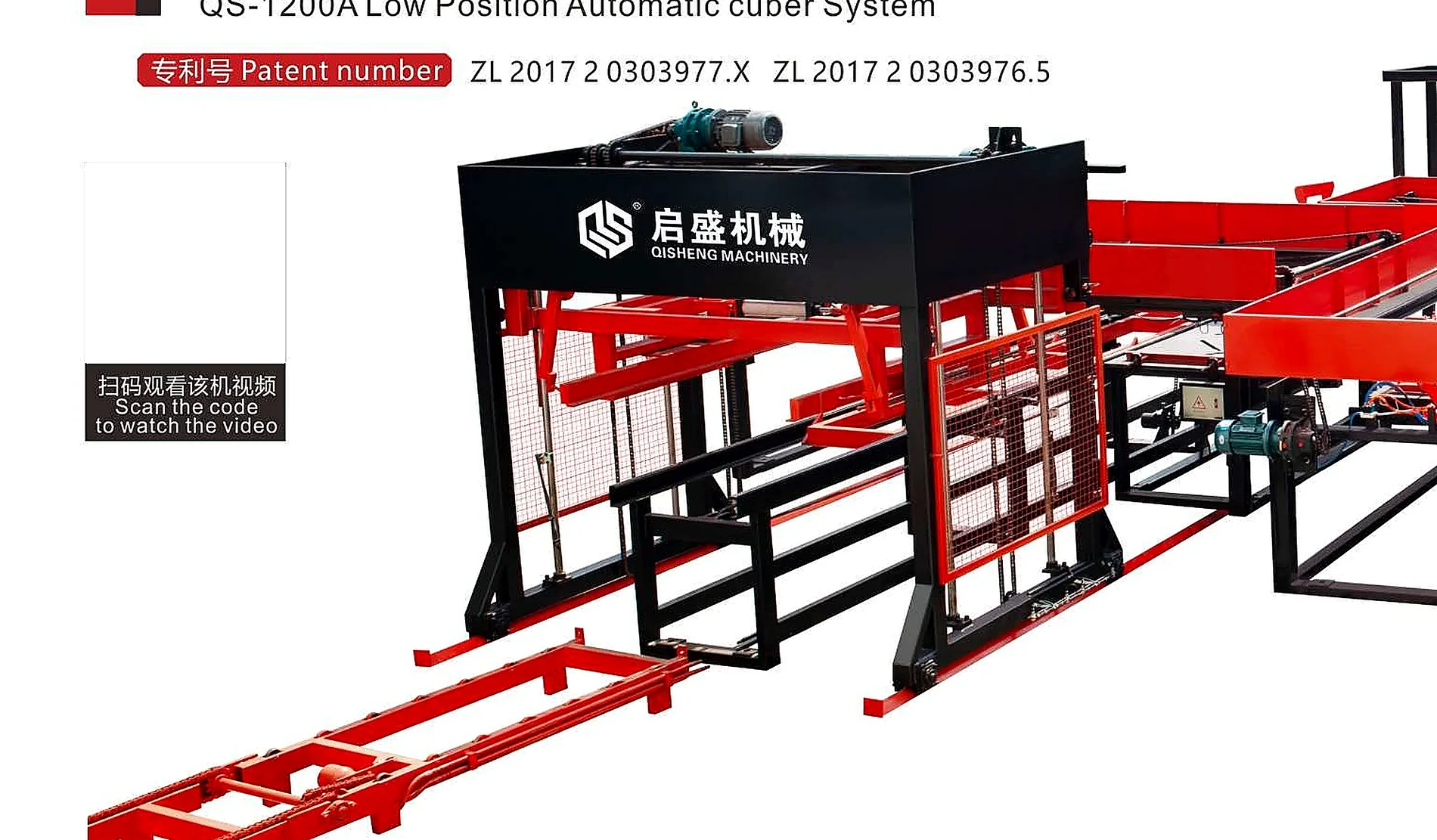
| Cubing | QS-1200A low-position, QS-1200B high-level, QS-1000G-A/B/C, QS-1000Y mobile | Separates bricks from pallets, arranges and rebuilds the stack, in-line or in the yard. |
| Packaging | QS cantilever wrapper, QSSX-16A and QSPY-16A balers | Wraps or straps palletised cubes for transport and storage. |
| Handling | QS series forklift clamp | Grips the finished stack directly for pallet-free yard stacking and truck loading. |
Builders who already own a block machine can still complete the plant around it. The QSDJ belt-rack line and the QSRGY finger-car line are both designed to run with a host machine of any manufacturer and any model, new or existing. That keeps an existing press in service while curing, cubing and packing are upgraded. See the concrete block production line range for the line-level equipment families.
Capacity Assumptions for a Complete Block Factory
Every output figure depends on conditions. Use the numbers below as a starting point, then confirm them against your block type, mould, cycle time, shift length and material stability.
| Host machine | Pallet size | Cycle time | Installed capacity | Stated output |
|---|---|---|---|---|
| QST1800 | 1,400 x 1,400 x 30 mm | 15 to 25 s | 104 kW | Up to 220,000 standard bricks per 8-hour shift |
| QST1500 | 1,350 x 1,150 x 30 mm | 15 to 23 s | 69.1 kW | Matched to your target output |
| QST1200 | 1,350 x 880 x 25 mm | 15 to 25 s | 57.6 kW | Up to 120,960 standard bricks per 8-hour shift |
| QST1000 | 1,100 x 880 x 25 mm | 15 to 23 s | 48.9 kW | Matched to your target output |
| QST8-15 | 980 x 860 x 22 mm | 15 to 23 s | 44.9 kW | Up to 90,000 standard bricks per 8-hour shift |
Three conditions move a real number more than anything else.
- Product type. A hollow block uses more material per piece and fewer pieces per mould than a thin solid brick, so the same machine returns a lower piece count.
- Cycle time. A 15-second cycle and a 25-second cycle on the same host differ by more than half in output across a shift.
- Curing throughput. If the curing system cannot store and return pallets fast enough, the host machine waits, however fast it is.
The QSGW line is configured from 30,000 to 250,000 pieces per 8-hour shift depending on the host machine, which is why one line family covers plants of very different sizes. Check typical figures against your own block mix with the block machine capacity guide.
Factory Requirements: Area, Power, Water and Foundation
Area
Footprint is driven by curing volume, not by the host machine alone. A high-level three-dimensional kiln such as the QSGW design uses building height and cuts the ground area needed for the same curing volume. A single-layer finger-car layout needs more floor for the same pallet count. Individual equipment footprints are fixed: the QS-1200A low-position cuber covers 12,000 x 3,000 mm, the QS-1000G-A fixed cuber measures 7,500 x 7,000 x 5,500 mm, and the QS-1000G-C double-station cuber covers about 19,000 x 7,500 x 5,500 mm. Plan the batching yard, moulding hall, curing area, cuber and finished-goods yard as separate zones, then confirm the total against your own site survey.
Power
The supply must cover the installed load of every driven machine running at the same time, plus a working margin. Reference installed capacities: QST1800 host machine 104 kW, QST1200 57.6 kW, QST8-15 44.9 kW, QS-1200A cuber 34.15 kW, QS-1000G-C double-station cuber 44 to 45 kW, QSMT1000 pallet-free cuber 57.5 kW. Equipment is built for a 380 V three-phase supply. The QSRGY sub-car can take track power of 380 V AC stepped down to 36 V DC on the running rail, or a 36 V lithium battery with an automatic charging pile. Confirm transformer and incoming-cable sizing against the final machine list, not against a single machine.
Water
Water is used for two things: gauging water in the mix and moisture during curing. The quantity follows your mix design and local climate rather than a fixed figure, so size storage and pumping from your own mix ratio and daily batch count. Keep a stable supply for the mixer, because every interruption forces a cycle stop and a wasted batch.
Foundation
The main machines are heavy and generate vibration. The QST1800 host machine weighs 34 t and the QST1200 weighs 17 t. Foundations for the host machine, mixer and batching plant must be cast to carry that dead weight plus dynamic loading, on ground that does not settle unevenly. Treat foundation drawings as part of the engineering package, released before shipment, so the concrete work runs during transit.
Manpower per Shift
Automation level decides the crew. The figures below come from the two automatic curing line families.
| Line element | Operators per shift | Note |
|---|---|---|
| QSGW high-level fully automatic line | 3 to 6 persons | Depends on configuration. Central computer and PLC drive the automatic cycle. |
| QSRGY finger-car curing line | 3 to 4 persons | Complete the whole production task. Automatic stop and fault-position display reduce specialist skill needs. |
| Single fixed cuber (QS-1000G-A) | One operator | Automatic or manual mode, two-way brick clamping. |
Fewer operators do not mean less skill. One trained person who understands the PLC screen, the fault codes and the mould change is worth more than four who only press buttons. Plan training around the control system and the daily mould-change routine, and agree who owns the mixer feed rate, because that single setting controls the rhythm of the whole line.
Cost Factors That Move the Budget
This page does not quote prices, because a final figure only exists after the configuration is fixed. These are the variables that move it.
- Host machine size. A QST1800 carries a very different cost from a compact QST8-15.
- Curing system type. A high-level kiln line, a rack-curing line and a finger-car line differ in steel, track and control content.
- Pallet count. Pallets circulate through the whole curing volume, so more curing volume means more pallets, and pallets are a real line item.
- Automation level. Automatic pallet feeding, automatic cubing and automatic packaging each add equipment and remove labour.
- Mould count. Every product you want to sell needs its own mould.
- Batching and mixing capacity. The PL Series batching machine and the CMP mixer are sized to the host machine cycle.
- Site works. Foundations, hardstanding, buildings and power supply are usually the buyer scope.
- Freight and installation. Distance, container count and on-site conditions all change the delivered total.
Delivery, Installation and Commissioning
A complete line ships as a project, not as a single crate, and sequence matters.
- Confirm the configuration and site conditions, then freeze the drawing set.
- Prepare foundations and the power supply to the released drawings before equipment arrives.
- Install the batching and mixing group, then the host machine, then transfer and curing, then cubing and packing.
- Commission each stage dry, then run the line as a connected loop.
- Train the operating crew on the control system, mould change and routine maintenance.
- Agree the spare-parts list for wear items before handover.
Build the line as a loop from day one. A plant commissioned stage by stage without an integrated test will lose output in the first weeks to small mismatches between cycle times that nobody traced.
Three layout mistakes show up again and again. First, a curing area sized for one shift when the plant runs two, which leaves pallets stacked in the open and exposed to rain. Second, a batching plant that can feed the mixer only at half the host cycle, so the press waits after every batch instead of running continuously. Third, a cuber placed at the end of a long pallet run instead of beside the curing exit, which adds travel time to every cycle. Fix these on the drawing, where a change costs an afternoon, not on site, where it costs a week.
How to Plan Your Complete Concrete Block Factory
Send five things and the plan writes itself: your block types and sizes in mm, your output target per shift, your site area and building height, your available power and voltage, and whether you own a host machine already. Those five answers decide the host model, the curing system, the pallet count and the crew. For regional demand and voltage habits, the Syria market page shows how the same equipment is matched to local conditions. When you are ready, Get Turnkey Plan and the reply sets out the equipment list, the layout logic and the power and manpower outline for your site.
Frequently Asked Questions
What is included in a complete concrete block production line?
How many blocks can a complete factory produce per day?
How much land does a turnkey block factory need?
What power supply does the line need?
How many workers does a block factory need per shift?
Can I build the line around a block machine I already own?
Which curing system should I choose?
What affects the total cost of a complete line?
Who installs the line and how is commissioning handled?
How do I compare two complete line quotations fairly?
Related machines
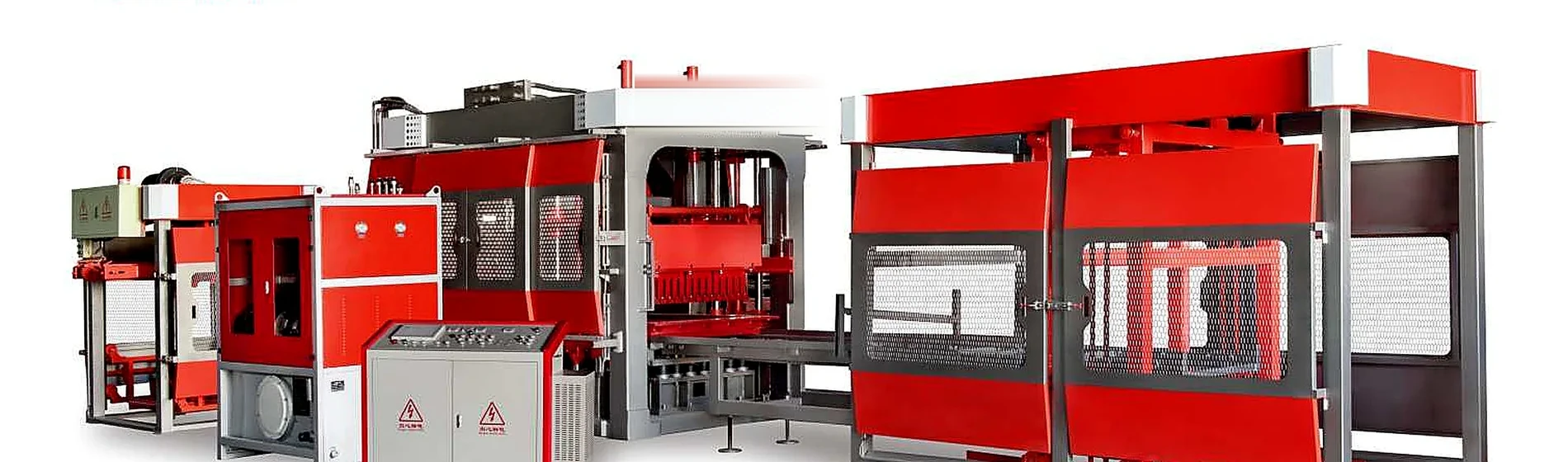
Concrete Block Making Machine
Core machine for hollow blocks, solid blocks, pavers and curbstones.
Automatic Block Making Machine
High-output automatic block machine for industrial production lines.
Hydraulic Block Making Machine
Hydraulic forming system for stable density and consistent blocks.
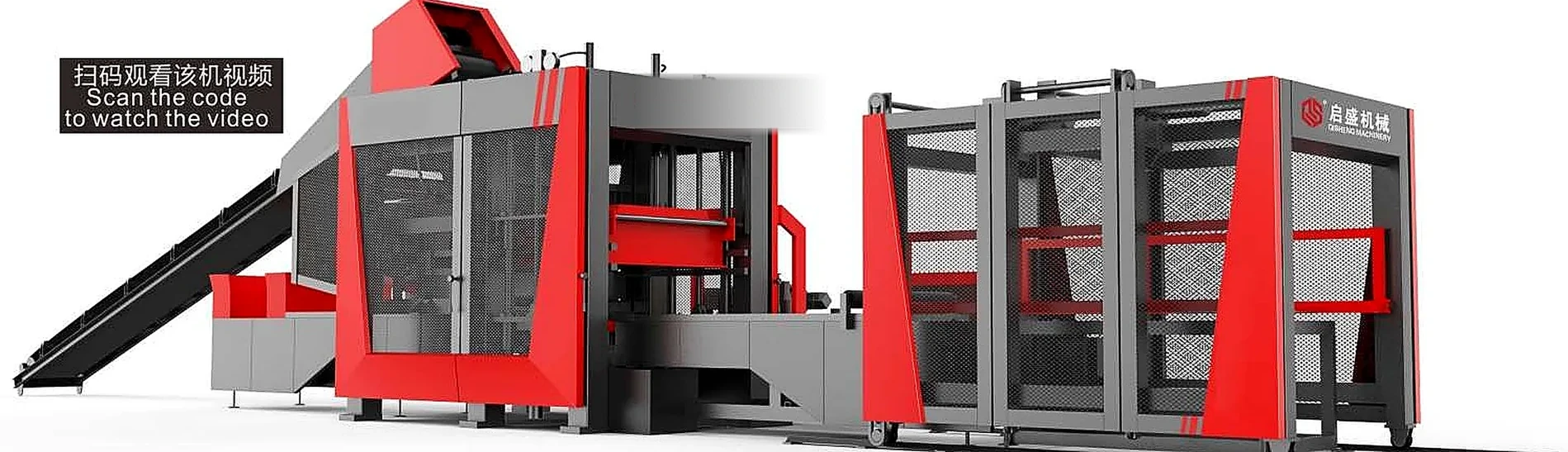
Hollow Block Making Machine
Machine configurations for common hollow concrete block sizes.