QS Series Forklift Clamp for Brick Handling
Move 500 to 800 standard bricks per lift with a 2000 kg hydraulic clamp and no pallets.
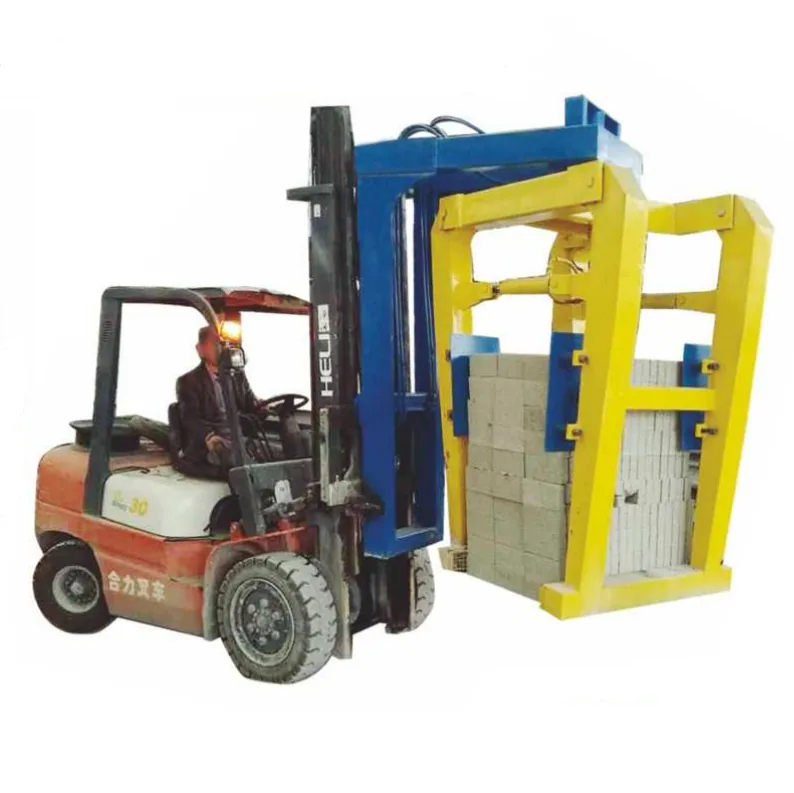
The QS series forklift clamp grips finished bricks directly so handling, stacking and loading run without pallets. It suits aerated concrete, autoclaved bricks, sintered bricks, non-fired bricks and precast concrete components, which means one attachment covers most of the block types a plant produces. The clamp is built on an all-steel integral frame for high strength and smooth running. Its clamping arms are shaped around the stress distribution of the load, so they hold a stack firmly without chipping or cracking the bricks. Hydraulic drive and left-right lateral movement give precise positioning and a wide field of view. A long stroke covers stacks of different widths, from 680 to 1150 mm at the arms, with a gripping width of 1000 mm and stack dimensions of 1000 by 1000 by 1000 mm. Load capacity reaches 2000 kg, enough for roughly 500 to 800 standard bricks or 40 hollow bricks per lift, stacked up to 10 layers of standard bricks or 5 layers of hollow bricks. Because bricks travel without pallets, the attachment cuts labor and removes the cost of buying, repairing and storing pallets. Plants use it to transfer and stack piles on the line, load bricks for delivery and rearrange stacks in storage.
Configured around output, blocks and operating conditions.
All-steel integral frame keeps rigidity high and operation smooth under repeated heavy lifts., Clamping arms shaped for even force distribution hold bricks firmly without chipping or cracking., Hydraulic drive with 100 mm lateral movement gives precise alignment between brick stacks., Long stroke from 680 to 1150 mm handles stacks of different widths on one attachment., Handles 500 to 800 standard bricks or 40 hollow bricks per lift with 2000 kg capacity., Works with standard bricks, hollow bricks, paving bricks and aerated blocks.
Typical decision factors
What changes the machine price?
Daily capacity
Output target determines machine size, mould cycles and line configuration.
Automation
Pallet handling, cubing, batching and packaging change total project scope.
Block types
Hollow block, paver, interlock and curbstone may require different moulds and handling.
Service scope
Shipping, installation, training and spare parts are quoted by destination.
Pallet-Free Brick Handling
The QS series forklift clamp grips finished bricks directly, so plants move, stack and load product without wooden pallets. It fits aerated concrete, autoclaved bricks, sintered bricks, non-fired bricks and precast concrete components, which means one attachment covers most of the block types a plant produces instead of several dedicated devices.
Working without pallets removes a material loop from the yard. No pallets means no purchasing, no repair shop, no return trip and no ground space held by empty pallet stacks, which is often the hidden cost in a brick handling operation.
Frame, Arms and Grip Quality
The clamp is built on an all-steel integral frame, giving high strength and smooth operation under repeated heavy lifts. The clamping arms are optimized for force distribution, so pressure spreads across the stack rather than concentrating at a few contact points. The result is a strong, stable grip that holds bricks firmly without chipping edges or cracking faces, which keeps more of the finished product sellable.
Structural optimization also keeps the operator's field of view open. Hydraulic drive runs the clamp, and the left-right lateral movement function covers 100 mm of travel, letting the operator line up one stack against the next with fine control instead of repositioning the whole forklift.
Coverage, Stroke and Capacity
A long stroke design lets the arms reach stacks of varying widths. The arm opening range runs from 680 to 1150 mm, with a gripping width of 1000 mm and a working stack size of 1000 by 1000 by 1000 mm. That spread means the attachment handles standard bricks, hollow bricks, paving bricks, eight-brick units and aerated blocks on the same machine.
Load capacity is 2000 kg, enough to lift around 500 to 800 standard bricks or 40 hollow bricks at a time, with the load stacked as high as 10 layers of standard bricks or 5 layers of hollow bricks. Handling at that scale moves large volumes per trip, so loading and yard work finish faster and need fewer operators compared with manual or pallet-based methods.
Where the Clamp Fits in a Line
The clamp is used to transfer and stack finished brick piles on production lines, to load and transport concrete bricks and aerated blocks without pallets, to organize and reposition finished stacks in factory storage areas, and to work alongside automated stacking and packaging lines. Because it is a forklift attachment, it plugs into equipment plants already run and does not require a new machine base.