QSSX-16A Overhead Rotary Automatic Strapping Machine
Overhead rotary head straps a full brick stack in about eleven seconds
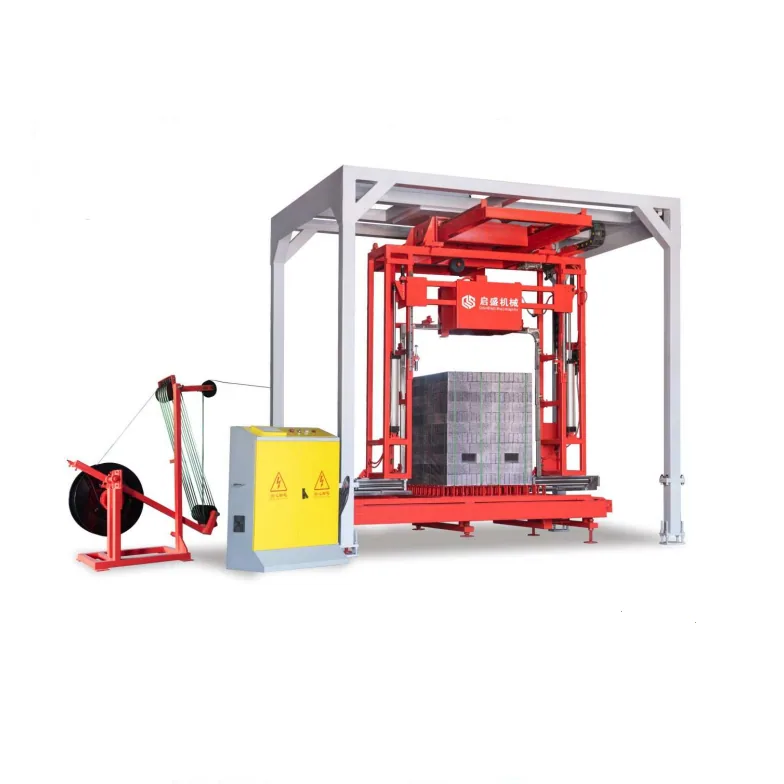
The QSSX-16A is an overhead rotary automatic strapping machine built for the packaging stage of brick stacks. The strapping head turns above the load rather than sitting in a fixed frame beside it, so the body stays compact and takes little floor space in a crowded dispatch area. That shape lets the unit join a fully automatic brick line and an intelligent palletizing system without redesigning the layout, giving a continuous flow from forming to stacking to packaging. A PLC works with photoelectric positioning sensors, and the whole cycle runs closed loop: strap feed, tensioning, heat sealing, cutting and mechanism reset all happen without anyone threading, trimming or tying by hand. The machine uses PET plastic steel strap with heat-sealed joints. A standard 1.2 cubic meter stack is wrapped in about 11 seconds. An arrow-type strap groove handles spaced pallets, so the unit adapts to different yard conditions. Packages leave the station the same shape every time, which simplifies loading and counting at dispatch.
Configured around output, blocks and operating conditions.
Overhead rotary strapping head gives a compact body and a small floor footprint, PLC with photoelectric positioning runs the cycle closed loop without manual handling, Automatic strap feeding, tensioning, heat sealing, cutting and mechanism reset, PET plastic steel strap with heat-sealed joints that hold through long transport, Standard 1.2 cubic meter stack wrapped in about 11 seconds, Arrow-type strap groove accommodates spaced pallets on the yard
Typical decision factors
What changes the machine price?
Daily capacity
Output target determines machine size, mould cycles and line configuration.
Automation
Pallet handling, cubing, batching and packaging change total project scope.
Block types
Hollow block, paver, interlock and curbstone may require different moulds and handling.
Service scope
Shipping, installation, training and spare parts are quoted by destination.
Why the Strapping Head Sits Overhead
Conventional strappers carry a fixed arch beside the load, and that arch decides how much room the machine needs and how the conveyor must be routed. The QSSX-16A turns the head above the stack instead. The body stays compact and the footprint small, which matters at the end of a brick line where palletizing equipment, conveyors and forklift traffic already compete for floor. Because the head rotates over the load, spaced pallets present no problem: the strap path still closes around the full stack.
A Closed Strapping Cycle
A PLC runs the sequence with photoelectric sensors that report the position of each incoming stack. The sequence covers feeding the strap, tensioning it, sealing the joint with heat, cutting it and resetting the mechanism. Nobody threads the strap through a guide, nobody ties a knot and nobody trims the loose end. Between the PLC and the sensors, the cycle repeats the same way on every stack, which is what keeps joints and tension consistent across a shift. The same closed loop meters strap length for each stack, so material use stays predictable and the crew reorders PET strap on a known schedule instead of by guesswork.
Strap Material and Load Security
The machine runs on PET plastic steel strap. Joints are heat sealed rather than mechanically crimped, and the sealed section bonds firmly, so a wrapped stack stays closed through storage and long road or sea transport. Tension is set within a working range of 200 to 2500 N, which covers light hollow brick packs and dense solid block stacks. The arrow-type strap groove also clears spaced pallets, so a plant does not have to buy a special board just to suit the strapper.
Fitting Into a Production Line
The unit links to the palletizing system and the packing conveyor without a redesign, giving a continuous automated flow from forming through stacking to packaging. It handles standard, hollow and porous bricks along with a range of concrete block stacks, which means a plant changing products during the week does not need a second machine. The structure is robust and routine maintenance is simple, so the equipment suits building material factories that want to automate the downstream end, present uniform packages at shipment and cut the labour the packing bay consumes. For a plant weighing the cost of that bay, the machine pays back through the operators it releases and the damaged packs it removes from the dispatch tally.