Aerated Block Hole-Keeping Palletizing Line QST1200
Automated line that sorts and re-palletizes aerated blocks while leaving forklift holes.
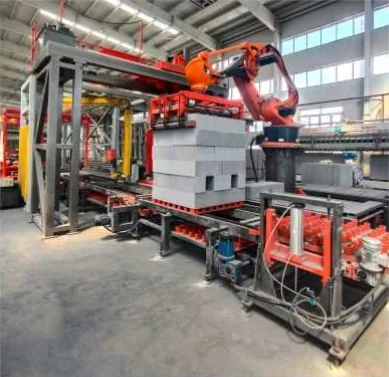
This production line handles the finish end of an aerated block plant. It takes the palletized brick blanks leaving the existing stacker, picks them up layer by layer, sorts them to a preset program, leaves forklift holes and re-palletizes them. The original stacker keeps working as usual, so the line is added rather than replaced. The process runs as one connected flow: de-palletizing, brick sorting, hole leaving, palletizing, and final product stacking and packaging. The result is fully automatic pallet-free palletizing and packaging with pre-drilled forklift holes. An integrated de-palletizing and palletizing robot does the pick-up, de-stacking, sorting and palletizing, using imported heavy-duty robots. It works with several brick-sorting and hole-leaving platforms and palletizing stations. A servo-driven mainline brick pusher moves blanks from the robot to the sorting platforms, keeping the flow tight without manual handling. The line comes in two versions: a composite type for molds that produce several brick types, and a single type for molds that produce only one. Different types can be sorted, hole-leaved and palletized at separate workstations by program.
Configured around output, blocks and operating conditions.
Connects to the existing finished-product stacker so the original line keeps running., Integrated de-palletizing and palletizing robot handles pick-up, de-stacking and sorting., Servo-driven mainline brick pusher moves blanks to the sorting platforms without manual handling., Composite and single-type versions match molds that make several brick types or only one., Leaves pre-drilled forklift holes for fully automatic pallet-free stacking and packaging., Multiple sorting, hole-leaving and palletizing stations run on one coordinated program.
Typical decision factors
What changes the machine price?
Daily capacity
Output target determines machine size, mould cycles and line configuration.
Automation
Pallet handling, cubing, batching and packaging change total project scope.
Block types
Hollow block, paver, interlock and curbstone may require different moulds and handling.
Service scope
Shipping, installation, training and spare parts are quoted by destination.
A Line Added to the Existing Plant
This production line is built around the way an aerated block plant already runs. Instead of replacing the finishing section, it connects directly to the finished-product stacker on the original line. It then picks up the palletized brick blanks layer by layer, sorts them according to a preset program, leaves forklift holes and re-palletizes them. The existing stacker continues working as normal, so production is not interrupted while the new section is brought in.
That approach suits plants that already have their main forming and curing operations in place and want to automate the handling and packaging stage without rebuilding the whole workshop.
One Connected Process Flow
The line integrates de-palletizing, brick sorting, hole leaving, palletizing, and final product stacking and packaging into a single sequence. Every stage hands off to the next without manual transfer, which keeps the cycle tight and the throughput high. The output is pallet-free palletizing and packaging with pre-drilled forklift holes, so the finished pack can be lifted by a forklift as it stands rather than being rehandled onto a pallet.
Automation is high and handling capacity is large. Sorting runs efficiently and the mechanisms work in close coordination, so the line holds its pace through a full shift instead of slowing as operators tire.
Robots and Handling Equipment
An integrated de-palletizing and palletizing robot performs pick-up, de-stacking, sorting and palletizing. It is built on imported heavy-duty robots that follow the preset program, which is what allows one unit to serve several sorting and palletizing stations. Working with it are multiple brick-sorting and hole-leaving platforms, plus palletizing stations where the blocks are rebuilt into a pack.
A servo-driven mainline brick pusher moves the blanks picked up by the robot to the sorting platforms. Servo drive gives the push a controlled, repeatable motion, which is important when the same move repeats thousands of times per shift.
Composite and Single-Type Versions
The line is available in two versions based on how the mold cuts. The composite type handles molds that produce several brick types at once, and the single type handles molds that produce only one type. In both cases, bricks can be sorted, hole-leaved and palletized at different workstations according to the preset program.
Adjustment and switching between brick types and speed settings are kept convenient, and users select the equipment configuration that fits their actual production needs. That flexibility matters for plants serving several markets or changing product mix through the year.