QSD Belt-Frame Curing Fully Automatic Block Production Line
Wet bricks sit on metal frames to cure in place, while lithium transfer vehicles move them
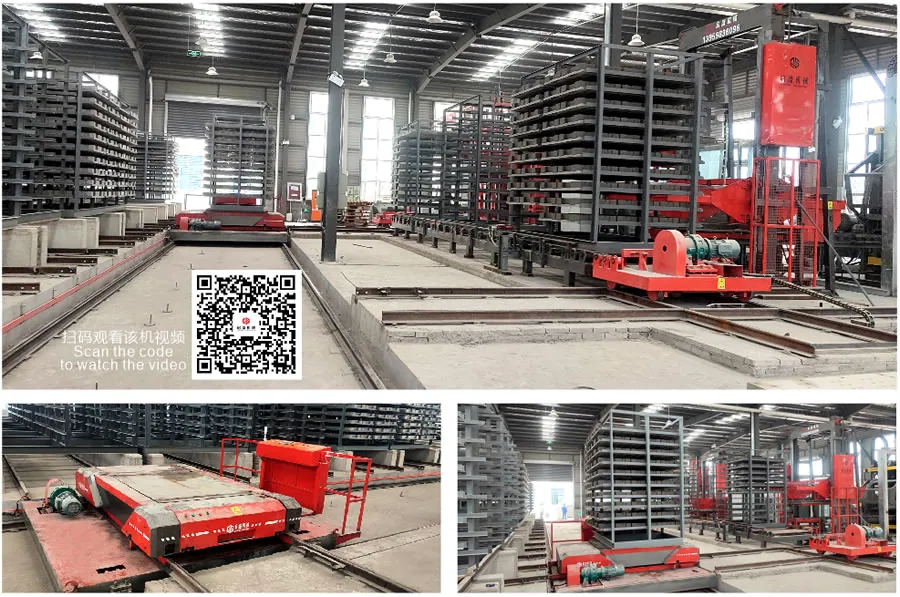
The QSD line groups five systems into one working whole: batching and mixing, pre-forming, belt-frame curing, brick sorting and stacking, and automatic packaging. Wet bricks leaving the forming stage are lifted layer by layer onto metal frames, and each layer of slabs is kept apart from the next. Once a frame is full, a forklift or a battery powered transfer vehicle carries it into the curing area or curing kiln. The transport vehicles run on lithium batteries and are controlled by a combined optical, mechanical, electrical and hydraulic system. A self-organising 485 wireless network links every unit in the line, and cloud connectivity allows the operation to be watched and faults to be traced from a distance, which eases after-sales servicing. The layout is arranged so the line can be matched to brick-making mainframes of any make, local or imported, and the configuration can be adjusted to fit the site, the machine already installed and the products being made. The result is a curing process that runs with less manual handling and a steadier daily output.
Configured around output, blocks and operating conditions.
Five systems in one line: batching and mixing, pre-forming, belt-frame curing, sorting and stacking, packaging, Wet bricks lifted layer by layer onto metal frames with each slab layer kept separate, Lithium battery transfer vehicles under combined optical, mechanical, electrical and hydraulic control, Self-organising 485 wireless network linking every component of the line, Cloud connectivity for remote monitoring of operation and remote fault tracing, Layout adaptable to brick-making mainframes of any make and to different site conditions
Typical decision factors
What changes the machine price?
Daily capacity
Output target determines machine size, mould cycles and line configuration.
Automation
Pallet handling, cubing, batching and packaging change total project scope.
Block types
Hollow block, paver, interlock and curbstone may require different moulds and handling.
Service scope
Shipping, installation, training and spare parts are quoted by destination.
The Five Systems in One Line
The QSD line is not a single machine but a group of systems working in sequence. Batching and mixing prepares the material, the pre-forming system shapes the wet bricks, belt-frame curing holds them through their early strength stage, brick sorting and stacking organises the product, and automatic packaging seals it for dispatch. Each part is sized for the others, so material leaves one stage at the rate the next stage can accept it. The complete line is laid out to keep the process flow short and predictable instead of routing loads back and forth across the yard.
Wet Bricks onto Metal Frames
In the pre-forming stage the wet bricks are lifted by a lifting platform and placed onto metal frames, with each layer of brick slabs separated from the layer below. Keeping the layers apart protects the green product while it is still soft and lets air reach every slab in the curing area. When a frame is full a forklift moves it to the curing zone, or a battery powered transfer vehicle carries it into the curing kiln. A lowering platform at the other end takes cured pallet bricks off the frames layer by layer and places them onto the pushing machine, so the frames keep circulating. Heavy pallet conveyors and empty pallet conveyors move loaded frames forward and return the empty ones to the lifting platform for reuse.
Lithium Transfer Vehicles and Line Networking
The transport vehicles in the line are powered by lithium batteries rather than diesel, and they work under combined optical, mechanical, electrical and hydraulic microcomputer control. A self-organising 485 wireless network connects every component, so vehicles, platforms and conveyors exchange their status within one system. Cloud connectivity adds remote monitoring of equipment operation and remote fault tracing, which shortens service visits and lets a plant resolve small stoppages before they grow into lost shifts.
Matching an Existing Plant
The configuration is arranged to connect with brick-making mainframes from any domestic or international supplier. A buyer who already owns a block machine can add the QSD arrangement around it rather than replacing the whole hall, and the offer can be adjusted for different site conditions and product types. Compared with similar imported equipment, the layout is more complete, the process flow is simpler and the acquisition cost is lower.
What the Buyer Gets
Fewer manual moves between forming, curing and packing, a curing stage that keeps every layer of bricks separate, and equipment status that can be seen from the office or from a service desk far away. The series is offered in QST1200 and QST1800 sizes for lines of different output, and it suits plants that are building a complete automatic line as well as plants upgrading the handling and curing side of an existing one.