QSPY-16A Traversing Automatic Strapping Machine
Traversing strap feed that keeps straps moving without jamming bricks
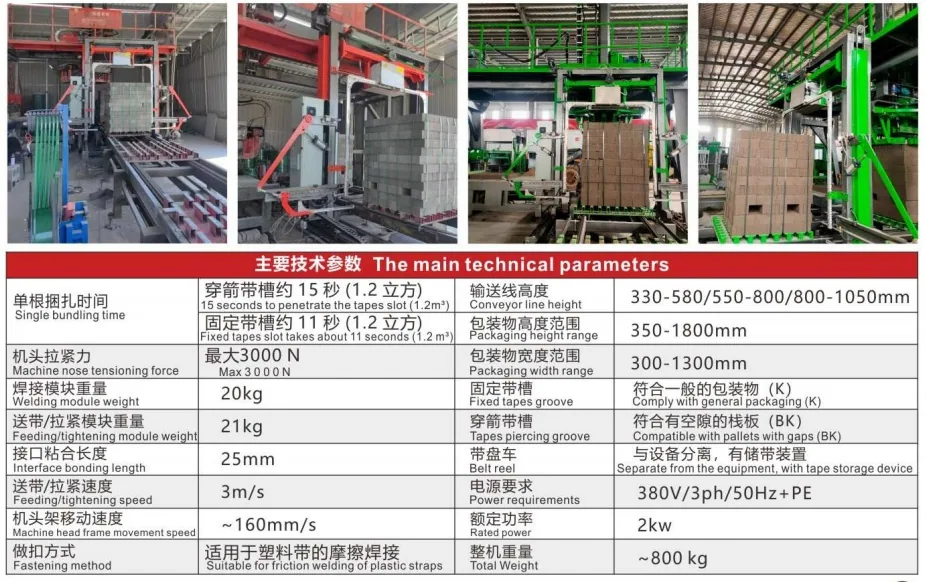
The QSPY-16A is a traversing automatic strapping machine that packs finished brick stacks at the end of a brick production line. Its strap feeding mechanism moves sideways across the load rather than sitting in a fixed frame, so the strap travels a clean path, positions accurately and does not jam or scratch the bricks. The unit links to stacking systems and conveyor lines and handles the packing stage on its own after the stack arrives. A PLC works with photoelectric sensing, and strap feeding, tightening, heat sealing, cutting and resetting all follow automatically. The machine runs on PET plastic steel strap and accepts stacks from 1 to 1.5 meters wide. Strapping tension is adjustable, and the control system reports its own faults. That combination keeps joints neat and stacks stable, which is what export packing bays need before container loading. It is a practical upgrade for plants whose packing still relies on hand tying and whose shipping standard varies from one order to the next.
Configured around output, blocks and operating conditions.
Traversing strap feed moves across the load for accurate positioning without jams, No metal frame abrasion, so brick edges stay intact and spoilage drops, PLC with photoelectric sensing automates feeding, tightening, sealing and cutting, Handles brick stacks from 1 to 1.5 meters wide on PET plastic steel strap, Adjustable strapping tension and self-diagnostic fault detection in the control system, Links to stacking lines, conveyor systems and forklift clamp workflows
Typical decision factors
What changes the machine price?
Daily capacity
Output target determines machine size, mould cycles and line configuration.
Automation
Pallet handling, cubing, batching and packaging change total project scope.
Block types
Hollow block, paver, interlock and curbstone may require different moulds and handling.
Service scope
Shipping, installation, training and spare parts are quoted by destination.
Traversing Feed Against Fixed Frames
A strapper with a fixed arch sends the strap around a rigid path before it meets the load, and on many sites that path is where jams start. The QSPY-16A moves the feed mechanism sideways across the stack instead. The strap follows a short and stable route, positions itself accurately and clears the brick faces without the metal frame abrasion that damages edges and raises spoilage on older fixed machines. The feed carriage also holds its alignment over time, so the unit does not develop the drifting strap path that fixed frames show after years of service.
Sequence and Control
A PLC runs the machine with photoelectric sensing for positioning. After the stack reaches the station, the strap is fed, tightened, heat sealed and cut, then the mechanism resets for the next stack, with no manual step in between. Tension is adjustable, so a hollow brick pack can be run lighter than a dense solid block stack. The control system also performs self-diagnostic fault detection, which points the maintenance crew at the part that needs attention instead of sending them through the whole machine.
Stack Sizes and Brick Types
The machine accepts brick stacks from 1 to 1.5 meters wide, a band that covers most packing pallets used in the trade. It runs PET plastic steel strap, and the sealed joints come out neat, so stacks hold their shape while they sit in the yard and while they travel. The unit works with standard, hollow and porous bricks as well as concrete blocks, and it keeps a wrapped pack intact for aerated concrete, permeable brick and paving brick products too.
Where It Earns Its Place on a Line
Typical duties are the packing stage at the end of a fully automatic brick line, strapping and handling of finished stacks during warehousing and transport, and pre-packing before export bricks go into containers. Older brick factories use it to convert a manual strapping station into an automated one, and the unit also joins intelligent hole-preserving stacking lines and forklift clamp production systems where a whole flow has already been automated down to the truck. The result is a steadier packing output, a lower labour bill and a shipping standard that stays the same from one order to the next. Because the wrap is uniform, shipment counts and package dimensions stop varying between shifts, which makes container planning more predictable for the export office.